Retargeting is often marketed as the “low-hanging fruit” of paid advertising.
Someone visits your website.
They don’t convert.
You show them ads again.
Simple.
But if it’s so simple, why do so many brands complain that retargeting “isn’t performing like it used to”?
The problem isn’t retargeting itself. It’s the structure behind it.
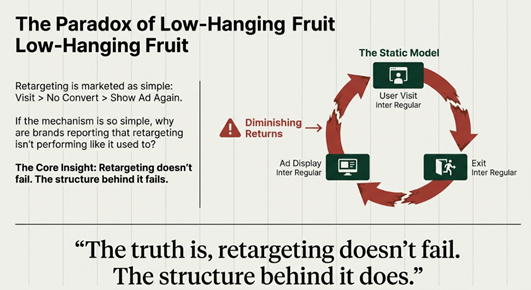
The truth is, retargeting doesn’t fail. The structure behind it does.
Let’s unpack what’s really going wrong.
They Treat All Visitors Like They’re at the Same Stage
Most brands create one basic audience:
“Website Visitors – 30 Days.”
And that’s where the strategy ends.
But here’s the issue — not all visitors have the same intent.
There’s a huge psychological difference between:
- Someone who bounced from the homepage
- Someone who viewed a product for 3 minutes
- Someone who added to cart
- Someone who initiated checkout
Here’s how intent actually breaks down inside a typical retargeting funnel:
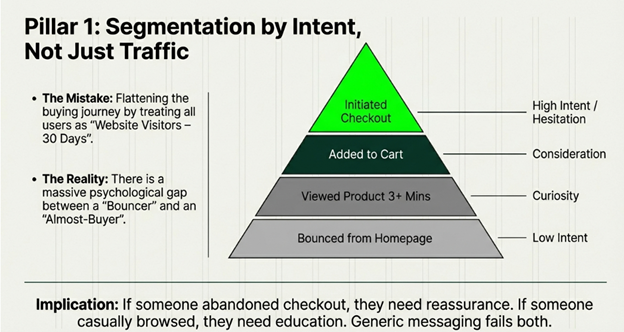
When you show the same ad to all of them, you flatten the buying journey.
Retargeting only works when it reflects intent. If someone abandoned checkout, they likely need reassurance or urgency. If someone casually browsed, they may still need education.
Without segmentation, your ads feel generic. And generic rarely converts.
They Confuse Repetition with Strategy
Another common mistake is creative repetition.
A brand launches one retargeting ad and keeps it running for weeks. Same image. Same copy. Same message. Instead, brands should focus on using authentic, user-generated creatives that evolve across the funnel to keep engagement high.
The assumption is simple:
“If they didn’t convert, they just need to see it more.”
But that’s not persuasion. That’s pressure.
Effective retargeting feels like a conversation progressing forward.
For example, a healthy creative sequence might look like:
- First touch → Reminder + core benefit
- Second touch → Social proof or testimonials
- Third touch → Objection handling (guarantee, FAQs)
- Fourth touch → Incentive or urgency
Notice how each step removes friction instead of repeating the same pitch.
When messaging evolves, conversions improve naturally. When it doesn’t, performance slowly declines.
Timing Is Often Ignored Completely
Most brands don’t think about when a message appears — only that it appears.
But timing changes perception.
Offering a discount immediately after someone visits your site can reduce perceived value. On the other hand, waiting too long can kill momentum.
Smart retargeting aligns messaging with time windows. For example:
- Day 1–3 → Value reinforcement
- Day 4–7 → Trust building
- Day 8–14 → Limited incentive
- Day 15+ → Scarcity or last reminder
When timing is structured, retargeting feels intentional.
When it isn’t, it feels random.
The Frequency Problem Nobody Talks About
Retargeting audiences are smaller by nature. That means ads are shown repeatedly to the same users.
If frequency isn’t controlled, users may see your ad:
- Multiple times per day
- Across different placements
- For weeks without variation
At that point, it shifts from brand familiarity to brand fatigue.
High frequency can lead to:
- Rising CPM
- Dropping CTR
- Negative brand perception
- Lower long-term trust
Retargeting should feel present — not overwhelming.
If someone notices your brand consistently in a helpful way, that builds familiarity.
If they feel chased, that builds resistance.
Retargeting Often Looks Better Than It Actually Is
Here’s something many brands don’t question enough:
Are those conversions truly incremental?
Retargeting campaigns often show strong ROAS in dashboards. But some of those users might have:
- Returned organically
- Converted through direct traffic
- Searched your brand name later
Retargeting ends up taking credit for conversions that were already likely to happen.
That’s why evaluating only campaign-level ROAS is risky.
Instead, brands should monitor:
- Blended customer acquisition cost
- Assisted conversions
- Overall funnel performance
The problem isn’t retargeting itself. It’s the structure behind it — especially when brands ignore how modern AI-driven advertising systems actually optimize campaigns in real time.
Budget Imbalance Creates a Growth Ceiling
Retargeting depends entirely on incoming traffic. If you’re working with limited budgets, understanding how to allocate spend effectively across cold and retargeting campaigns becomes even more critical.
If you don’t feed the top of your funnel, your retargeting pool shrinks. Yet many brands allocate a large portion of their budget to retargeting because “it converts better.”
Over time, this leads to:
- Smaller active audiences
- Increasing frequency
- Performance stagnation
- Slower overall growth
A healthier structure usually looks like:
- Majority budget toward cold acquisition
- Controlled allocation toward retargeting
- Smaller portion for loyalty or upsell
Retargeting supports growth. It doesn’t create it by itself.
What Effective Retargeting Actually Feels Like
When retargeting is structured properly, it feels intelligent.
It is:
- Segmented by intent
- Sequenced creatively
- Time-aligned
- Frequency-controlled
- Measured holistically
Most importantly, it respects user psychology.
Retargeting isn’t about chasing people across the internet. It’s about continuing a conversation that already started — in a way that feels relevant.
When brands fail at retargeting, it’s rarely because the concept stopped working.
It’s because the strategy never evolved.
Fix the structure, and retargeting becomes one of the most efficient profit drivers in your entire marketing system.
Ignore it, and it quietly drains budget while appearing “decent” on the surface.
Conclusion
Retargeting was never meant to be a shortcut. It was meant to be a refinement tool.
When brands treat it like a safety net instead of a structured system, it underperforms. Not because the audience is “burnt out.” Not because platforms stopped working. But because the strategy behind it never matured.
Effective retargeting isn’t about showing more ads.
It’s about showing the right message, to the right segment, at the right time, with the right frequency.
If your retargeting feels repetitive, overly aggressive, or disconnected from user intent — it’s not a performance issue. It’s a structural issue.
The brands that win with retargeting understand one thing clearly:
Retargeting doesn’t create demand.
It converts existing intent — thoughtfully.
When you segment properly, sequence your creatives, align timing, control frequency, and measure incrementality — retargeting stops being “decent” and starts becoming predictable, scalable, and profitable.
Fix the structure.
And retargeting becomes leverage.