Staying ahead in marketing takes more than creativity alone. Teams also need systems that help them work faster, generate better ideas, and stay consistent across campaigns.
That is why more businesses are using AI prompts in their daily workflows.
AI prompts can help marketing teams brainstorm blog topics, write social media posts, improve SEO, analyze customer feedback, create email campaigns, and even develop better ad copy. Instead of spending hours starting from scratch, marketers can use AI to speed up repetitive tasks and focus more on strategy.
When used correctly, AI prompts do not replace your team. They simply help your team work smarter.
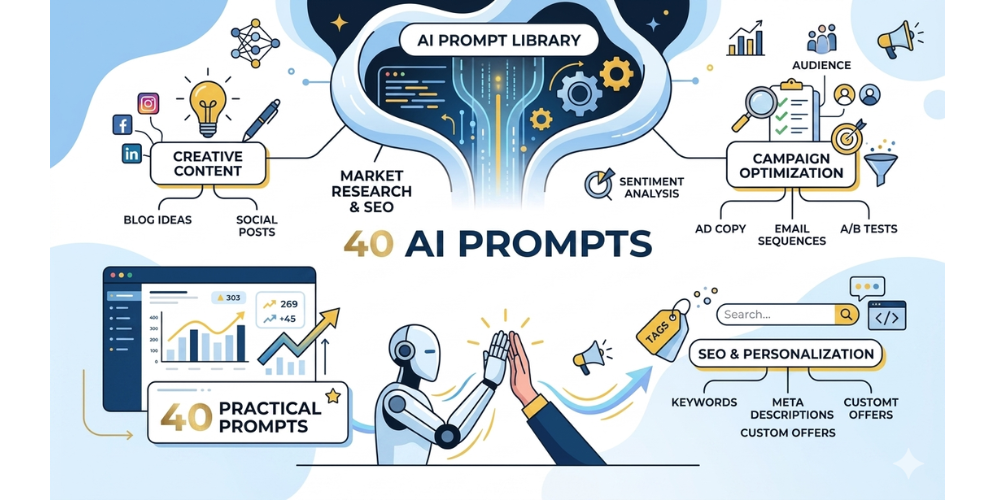
In this guide, we will explain how AI prompts can improve marketing performance, how to write better prompts, and 40 practical AI prompts you can start using right away.
Why AI Prompts Matter in Marketing
Marketing teams often manage multiple campaigns, channels, deadlines, and audience segments at once. Because of this, it is easy to spend too much time on repetitive tasks such as drafting emails, researching topics, writing meta descriptions, or reviewing customer feedback.
While AI helps speed up content creation, improving rankings also depends on building high-quality backlinks.
AI prompts can help reduce this workload. To get the best results from AI prompts, it’s important to first understand your audience, their needs, and behavior through detailed audience research strategies.
With the right prompt, AI can:
- Generate fresh blog ideas
- Write social media captions faster
- Improve email subject lines
- Analyze customer reviews
- Identify keyword opportunities
- Create ad copy variations
- Personalize content for different audiences
- Help teams make faster decisions
This means your marketing team can spend less time on manual tasks and more time on activities that actually drive growth.
How to Write Better AI Prompts
The quality of your output depends on the quality of your prompt. A vague prompt often leads to vague results. A clear prompt gives AI more direction and produces more useful content.
Here are a few ways to write stronger AI prompts:
Be Clear and Specific
Instead of writing:
“Write a blog post.”
Try:
“Write a 700-word blog post about eco-friendly packaging trends for small ecommerce businesses.”
The more details you provide, the better the result will be.
Add Context
Explain your audience, industry, product, or goal.
For example:
“Create Instagram captions for a skincare brand targeting women between 25 and 40 who prefer natural products.”
This helps AI produce more relevant content.
Include Examples
If you want a specific tone or format, provide an example.
For example:
“Write a product description similar in tone to Apple’s website copy.”
Examples give AI a stronger direction.
Define the Goal
Tell AI exactly what you want the content to achieve.
For example:
“Write an email subject line that increases open rates for a limited-time sale.”
This makes the output more focused.
Test and Improve
Your first prompt may not always give you the perfect answer. Keep refining it by adding more details or changing the wording.
Over time, your team will learn which prompt styles produce the best results.
40 Best AI Prompts for Marketing Teams
AI prompts can support almost every part of your marketing strategy. Below are some of the best prompts to use across content creation, SEO, market research, campaign optimization, and personalization.
Content Creation Prompts
Creating high-quality content consistently becomes easier when you follow proven content growth strategies used by successful blogs.
1. Generate Blog Post Ideas
“Suggest 10 blog post ideas related to eco-friendly packaging trends for our blog.”
2. Find Trending Topics
“What are the current trending topics in the [industry] that we can cover in our next blog post?”
3. Create Product Comparison Ideas
“Suggest product comparison topics that can help customers understand how our product is different from competitors.”
4. Draft a Blog Post
“Write a 500-word blog post about the benefits of [topic].”
5. Write Social Media Posts
“Create three LinkedIn posts promoting our upcoming webinar about [topic].”
6. Draft Newsletter Content
“Write an introduction for our monthly newsletter highlighting new product updates and customer success stories.”
7. Create a Guest Post Pitch
“Draft a guest post pitch for [website name] about AI-driven marketing strategies for small businesses.”
8. Write a Collaboration Email
“Write an email to a potential brand partner proposing a content collaboration.”
9. Draft a Press Release
“Create a press release announcing our new product launch and explain its main benefits.”
10. Repurpose Existing Content
“Turn this blog post into five short social media captions and one email summary.”
Market Research Prompts
11. Summarize Customer Feedback
“Analyze customer reviews from the past quarter and summarize the main themes.”
12. Identify Customer Pain Points
“Find the top three pain points customers mention in reviews of our product.”
13. Perform Sentiment Analysis
“Analyze social media comments about our brand and identify whether the sentiment is positive, negative, or neutral.”
14. Conduct a Competitor SWOT Analysis
“Perform a SWOT analysis of our top competitor.”
15. Compare Competitor Performance
“Create a report comparing our social media engagement with our top three competitors.”
16. Build Audience Profiles
“Create audience profiles for our target customers, including demographics, interests, and buying behavior.”
17. Map the Customer Journey
“Outline the customer journey for someone purchasing from our online store.”
18. Segment Customers
“Group our customers into segments based on buying history and engagement levels.”
19. Analyze Purchase Behavior
“Identify common purchasing patterns among repeat customers.”
20. Find Market Gaps
“Identify gaps in the market that our brand could target with a new product or service.”
Campaign Optimization Prompts
21. Generate Ad Copy Variations
“Create three ad copy versions for our new product targeting [audience].”
22. Highlight Product Benefits
“Write ad copy that explains how our product solves customer problems.”
23. Create A/B Test Ideas
“Write two different ad headlines for our summer sale campaign.”
24. Suggest Email Subject Lines
“Generate five email subject lines for our product launch newsletter.”
25. Personalize Subject Lines
“Create personalized email subject lines using the customer’s first name and recent purchase history.”
26. Add Urgency to Promotions
“Write email subject lines that create urgency for a limited-time offer.”
27. Improve Landing Page Copy
“Rewrite our landing page headline to make it more compelling and conversion-focused.”
28. Create Retargeting Ads
“Write retargeting ad copy for users who visited our website but did not complete a purchase.”
29. Build a Webinar Promotion Campaign
“Create a full email sequence promoting our upcoming webinar.”
30. Optimize Call-to-Action Buttons
“Suggest five stronger call-to-action phrases for our product page.”
Personalization Prompts
31. Recommend Products
“Suggest personalized product recommendations based on a customer’s browsing history.”
32. Recommend Content
“Provide blog article recommendations based on what the customer has read before.”
33. Create Custom Offers
“Generate personalized offers for customers based on their previous purchases.”
34. Write Dynamic Email Content
“Draft an email that changes based on the customer’s previous interactions with our brand.”
35. Create Cart Abandonment Emails
“Write a cart abandonment email encouraging the customer to complete their purchase.”
SEO and Analytics Prompts
To get better results from these SEO prompts, it’s important to understand how to perform keyword research for SEO.
36. Find High-Traffic Keywords
“Generate 20 high-traffic keywords related to [topic].”
37. Suggest Long-Tail Keywords
“Suggest five long-tail keywords for a product page about [topic].”
38. Identify Competitor Keywords
“List the keywords our main competitor ranks for that we do not currently target.”
39. Write Meta Descriptions
“Write an SEO-friendly meta description for a blog post about [topic].”
40. Conduct an SEO Audit
“Review our website and identify SEO issues that may be hurting our rankings.”
How to Add AI Prompts to Your Marketing Workflow
You do not need to completely change your existing process to start using AI prompts.
Begin by identifying the tasks that take your team the most time. This could be content planning, writing emails, researching competitors, or optimizing SEO.
From there, create a small library of prompts that your team can reuse. Over time, you can improve those prompts based on what works best.
For example:
- Save prompts for social media captions
- Create templates for blog outlines
- Build reusable prompts for email subject lines
- Store competitor analysis prompts in one document
- Create SEO prompt templates for future blog posts
The more consistent your team becomes with prompt writing, the better your results will be.
Final Thoughts
AI prompts are quickly becoming an important part of modern marketing.
They help teams save time, improve content quality, generate better ideas, and work more efficiently. Whether you need help with blog topics, ad copy, SEO, email campaigns, or customer research, the right AI prompt can make a major difference.
The key is to be clear, specific, and willing to refine your prompts over time.
As AI continues to evolve, understanding AI-driven search trust signals will become increasingly important for marketers who want to stay ahead.