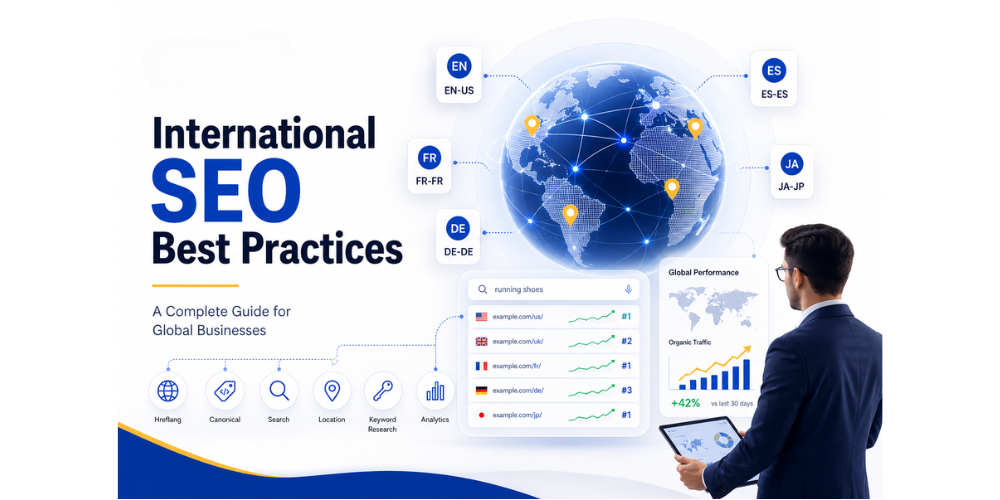
Expanding into new markets is one of the fastest ways to grow organic traffic — but most businesses get international SEO wrong before they even publish a single page. They translate content instead of localizing it, skip hreflang entirely, or pick a URL structure that fights against their own rankings.
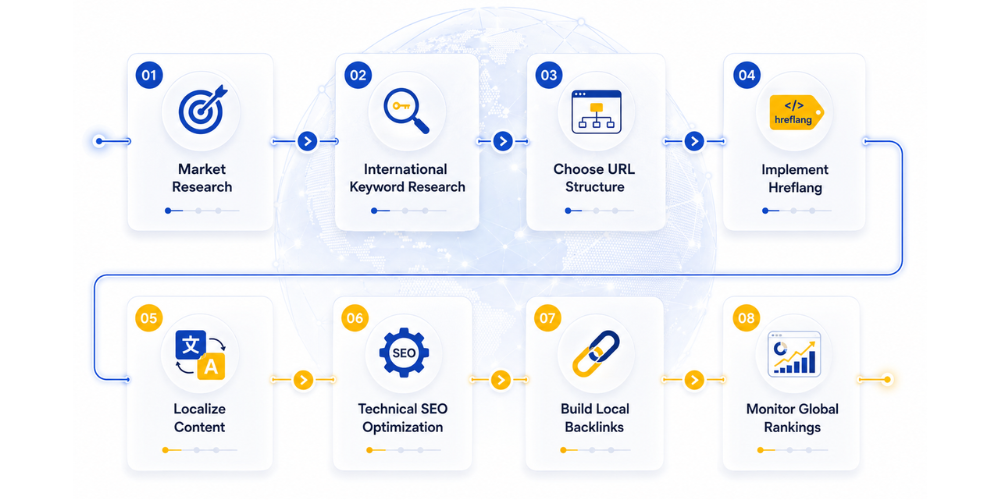
This guide covers what actually works: keyword research across markets, choosing the right URL structure, implementing hreflang correctly, localizing content instead of just translating it, and the technical SEO decisions that determine whether search engines understand your site at all.
Table of Contents
- What Is International SEO?
- Why International SEO Matters for Global Businesses
- How Search Engines Understand International Websites
- International SEO Best Practices
- Perform International Keyword Research for Each Market
- Choose the Right URL Structure
- Implement Hreflang Tags Correctly
- Localize Content Instead of Just Translating It
- Optimize Technical SEO for Multiple Regions
- Build Local Backlinks in Each Market
- Optimize for Local Search Intent
- Monitor Performance Separately by Market
- Is International SEO Right for Your Business?
- International SEO Readiness Checklist
- Common International SEO Mistakes
- International SEO vs. Local SEO
- International SEO Tools
- Frequently Asked Questions
- Conclusion
What Is International SEO?
International SEO is the process of optimizing a website so search engines can identify which countries and languages you want to target, and serve the right version of your content to the right audience. It differs from standard SEO in one key way: instead of optimizing a single site for a single audience, you’re managing multiple audience segments — often across languages, currencies, and search behaviors — from one connected structure.
For a business that’s only ever optimized for one market, this introduces new variables: duplicate content risk, crawl budget management, and signals like hreflang that don’t exist in a single-market strategy at all.
Why International SEO Matters for Global Businesses
Businesses expanding into new markets are essentially starting their SEO over — but with a shortcut. Instead of building authority from zero, you’re extending an existing domain’s trust into new territory. Done well, this shows up as:
- Organic visibility in markets you haven’t actively marketed in yet
- Traffic from multilingual audiences searching in their own language and phrasing
- Lower customer acquisition cost compared to paid expansion into a new region
- Stronger brand presence across every market you operate in, not just your home market
Done poorly, it shows up as pages competing against each other, the wrong country version ranking for the wrong audience, or content that never gets indexed at all.
How Search Engines Understand International Websites
Search engines rely on a combination of signals to figure out who a page is for: the language of the content itself, hreflang annotations, server location, ccTLD (if used), and even the local backlink profile pointing to a page. Most blogs stop at “add hreflang” — but search engines are weighing all of these signals together, which is why a page can have perfect hreflang and still rank in the wrong country if the other signals contradict it.
This is also why international SEO audits often turn up mismatched signals: a .co.uk domain with no UK-specific content, or a page targeted at Germany with no German backlinks pointing to it at all.
International SEO Best Practices
1. Perform International Keyword Research for Each Market
The single most common mistake in international SEO is assuming a keyword performs the same way everywhere. It doesn’t. A term that has strong search volume in the US can have almost no demand in the UK, Germany, or Australia — even in the same language.
A simple example: a “cell phone” in the US is a “mobile phone” in the UK and often just “mobile” in Australia. Direct translation misses all of this. Every market needs its own keyword research, done in the local language and against local search behavior — not translated from your home-market list.
2. Choose the Right URL Structure
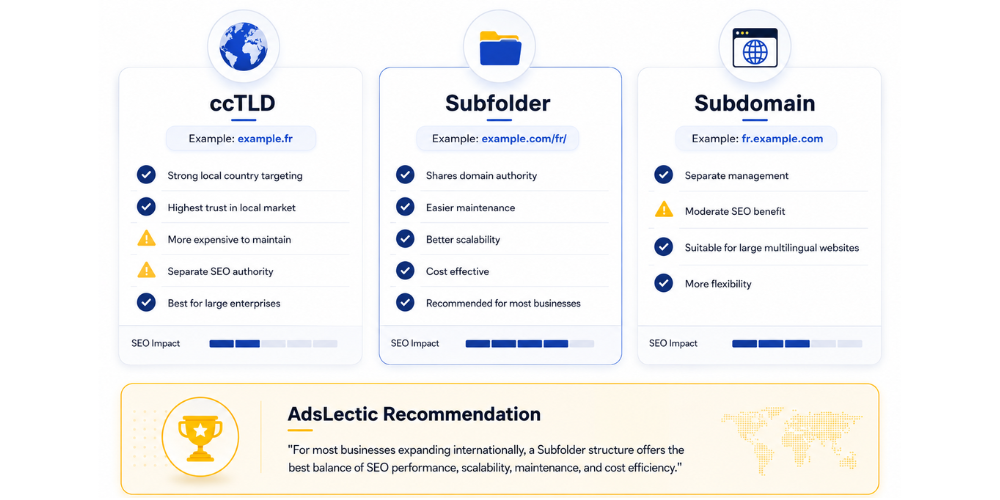
This is one of the most consequential — and most permanent — decisions in international SEO. There are three main structures:
| Structure | Example | Best For |
|---|---|---|
| ccTLD | example.de | Enterprises with resources for separate domains per country; strongest local trust signal |
| Subdirectory | example.com/de/ | Most businesses — easiest to maintain, inherits domain authority |
| Subdomain | de.example.com | Mid-size sites needing some separation without a fully separate domain |
| Business Type | Recommended Structure |
|---|---|
| Small business | Subdirectory |
| Enterprise | ccTLD |
| Ecommerce | Subdirectory |
| SaaS | Subdomain |
For most growing businesses targeting multiple countries, a subdirectory structure combined with correct hreflang implementation offers the best balance of scalability, maintenance, and SEO performance. Larger enterprises with distinct regional operations and dedicated local teams may benefit more from ccTLDs.
3. Implement Hreflang Tags Correctly
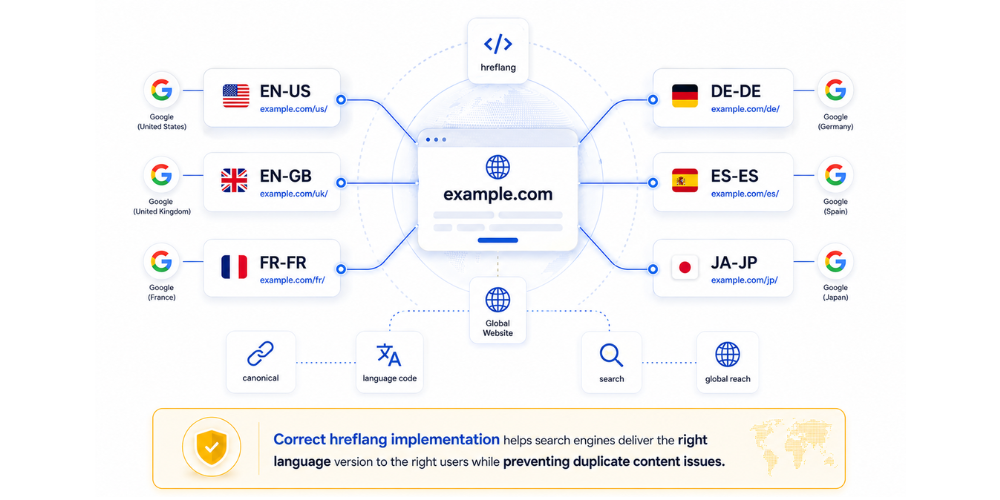
Hreflang tells search engines which language and country version of a page to serve to a given user. It doesn’t boost rankings directly, but it prevents your own pages from competing with each other and cannibalizing traffic.
html
<link rel="alternate" hreflang="en-us" href="https://example.com/us/" />
<link rel="alternate" hreflang="en-gb" href="https://example.com/uk/" />
<link rel="alternate" hreflang="fr-fr" href="https://example.com/fr/" />
<link rel="alternate" hreflang="x-default" href="https://example.com/" />
Each tag needs a matching return tag on the page it points to — this is where most implementations break. Other common mistakes:
- Using country codes without language codes (or vice versa)
- Missing the
x-defaulttag for users outside any targeted region - Hreflang tags that point to a page that no longer exists or redirects elsewhere
4. Localize Content Instead of Just Translating It
Translation changes the words. Localization changes the experience. A page that’s only translated will still show US pricing in dollars, US date formats, and cultural references that don’t land outside their original market. Localization adjusts currency, date format, measurement units, imagery, and examples so the content feels native to the reader — not translated at them.
This is one of the highest-leverage EEAT signals available in international SEO, because it’s directly visible to both users and search engines evaluating content quality for a given locale.
5. Optimize Technical SEO for Multiple Regions
International sites introduce technical SEO problems that don’t exist on single-market sites:
- Canonical tags need to point to the correct localized version, not just the “main” page
- Crawl budget matters more as page count multiplies across languages and regions
- Duplicate content risk rises when translated pages are too similar structurally
- XML sitemaps should be segmented by language or region for easier crawling
- Core Web Vitals should be monitored per region, since server location and CDN configuration can affect load times differently across markets
6. Build Local Backlinks in Each Market
A backlink from a French publication carries more local ranking weight for your French pages than a backlink from a US site ever will. Search engines use the geographic and linguistic context of linking domains as part of how they determine relevance for a given market — so a link-building strategy built entirely around your home market won’t necessarily transfer to new ones.
7. Optimize for Local Search Intent
The same keyword can mean different things in different markets. “Car insurance” in the US typically implies a commercial, purchase-ready search. In markets with different insurance systems or regulations, the same phrase might carry a more informational intent. Assuming intent is identical across markets is a common cause of otherwise well-optimized pages underperforming.
8. Monitor Performance Separately by Market
Set up Google Search Console and Analytics to segment by country and language, not just aggregate traffic. A page can be growing in one market and declining in another while the combined number looks flat — which hides the exact problem you need to fix.
Is International SEO Right for Your Business?
| Business Type | Need International SEO? |
|---|---|
| Local restaurant or clinic | No |
| SaaS company | Yes |
| Ecommerce brand shipping worldwide | Yes |
| B2B software company | Yes |
| Manufacturing export company | Yes |
If you’re managing hundreds of pages across multiple languages, expanding a multilingual ecommerce catalog, or planning SaaS expansion into new regions, this is usually where an experienced international SEO agency adds the most value — simplifying the technical implementation, localization, and ongoing optimization that’s easy to get wrong at scale.
International SEO Readiness Checklist
- Does every language version have a unique, indexable URL?
- Is hreflang implemented correctly, with matching return tags?
- Has keyword research been done separately for each target market?
- Is content localized — currency, dates, units, imagery — not just translated?
- Are XML sitemaps segmented by language or region?
- Are local backlinks being earned in each target market?
- Is performance being tracked separately by country and language?
Common International SEO Mistakes
- Using machine translation without a native-language review
- Missing or mismatched hreflang return tags
- Duplicate translated pages competing against each other
- Ignoring local search intent differences for the same keyword
- Mixing languages within a single page
- Choosing a URL structure that doesn’t match the business’s resources for maintaining it
International SEO vs. Local SEO
| International SEO | Local SEO | |
|---|---|---|
| Goal | Rank across multiple countries/languages | Rank in a specific city or region |
| Key signals | Hreflang, ccTLD/subfolder structure, localization | Google Business Profile, local citations, reviews |
| Content approach | Localized per market | Geographically specific |
| Typical business | Ecommerce, SaaS, enterprise brands | Restaurants, clinics, service businesses |
International SEO Tools
Google Search Console and Google Analytics remain the foundation for tracking performance by market. For research and auditing, Semrush, Ahrefs, and Screaming Frog cover keyword research, backlink analysis, and technical crawling. For managing multilingual content itself, tools like Weglot, WPML, and TranslatePress handle translation and hreflang management within CMS platforms like WordPress.
Frequently Asked Questions
International SEO is the practice of optimizing a website so search engines can correctly identify and serve the right country and language version of your content to the right audience.
Hreflang is an HTML attribute that tells search engines which language and regional version of a page to show to users based on their location and language settings.
No. Translation converts the words; localization adapts currency, units, cultural references, and examples so content feels native to that market — which search engines and users both respond to differently than a direct translation.
It depends on the business. Subdirectories work well for most growing businesses due to lower maintenance and shared domain authority; ccTLDs suit larger enterprises with dedicated regional resources.
Most businesses see better results starting with one or two high-opportunity markets, validating the approach, and expanding — rather than launching many languages at once with limited localization resources for each.
Google can machine-translate pages in search results for users, but this doesn’t replace proper localization and hreflang implementation, which determine indexing and ranking behavior, not just display.
Timelines vary by market competitiveness and existing domain authority, but most businesses see measurable movement within a few months of correct technical implementation, with compounding growth as local backlinks and content authority build over time.
Yes — ecommerce businesses shipping to multiple countries typically see some of the clearest ROI from international SEO, since it directly connects to markets they’re already able to sell into.
Conclusion
Expanding into international markets takes more than translating your website. From multilingual keyword research and technical implementation to localization and hreflang, a well-planned international SEO strategy determines whether your business is actually visible in the markets you’re trying to reach.
If you’re planning global expansion and need a strategy built around your specific markets and resources, AdsLectic can help you build an international SEO framework tailored to your business goals. For related technical groundwork, our Core Web Vitals guide and technical SEO audit checklist cover the site health fundamentals that any international SEO strategy is built on.

![Hindi SEO Guide 2026: SEO Kya Hai, SEO Kaise Kare and How to Rank in Hindi Suggested slug: /hindi-seo-guide/ Meta title: Hindi SEO Guide 2026: SEO Kya Hai & SEO Kaise Kare Meta description: Hindi SEO guide: learn seo kya hai, seo kaise kare, Hindi keyword research, on page and off page SEO, and how to rank in Google AI Mode in Hindi. Primary keyword: hindi seo Secondary keywords: seo for hindi website, hindi keyword research, seo kaise kare, seo kya hai, seo ka matlab, ai mode kya hai, google ai mode hindi Publishing notes (delete before going live): add one real client example where marked [ADD], and adjust the two Adslectic call-to-action lines to match what your SEO page actually offers. Hindi SEO means optimizing your website, blog or landing pages so they rank when people search Google in Hindi, Hinglish or a mix of both. If you have ever typed 'seo kya hai' or 'seo kaise kare' into Google, you have already done the kind of search this guide is about. Many Indian business websites are still English-only, even though a large part of their audience searches in Hindi. That gap is an opportunity. In this guide you will learn what SEO is in simple Hindi, how Hindi keyword research works, how to handle on-page, off-page and local SEO for a Hindi website, and how to show up in Google AI Mode answers in Hindi. SEO Kya Hai? (SEO Ka Matlab and Meaning in Hindi) SEO का मतलब है Search Engine Optimization (सर्च इंजन ऑप्टिमाइज़ेशन)। आसान शब्दों में, SEO वह तरीका है जिससे आपकी वेबसाइट या ब्लॉग Google जैसे सर्च इंजन में ऊपर दिखती है, ताकि सही लोग आपको आसानी से ढूंढ सकें। In simple terms, SEO is the process of making your website easy for search engines to understand and useful for the people searching. Whether someone asks 'seo kya hota hai' or looks up 'seo meaning in hindi', the answer is the same: SEO helps the right visitors find your pages without you paying for every click. SEO has three main parts: • On-page SEO: what you do on the page itself, such as content, titles, headings and images. • Off-page SEO: what happens outside your site, mainly backlinks and brand mentions. • Technical SEO: how fast, mobile-friendly and crawlable your site is. Hindi SEO applies all three to Hindi-language content. Why Hindi SEO Matters in 2026 • India had about 886 million active internet users in 2024, and rural India made up 55% of them, according to the IAMAI-Kantar Internet in India report. • The same report found that 98% of users access content in Indic languages, and 57% of urban users prefer regional-language content. • Google launched AI Mode in Hindi in September 2025, then added seven more Indian languages and Search Live in October 2025. • Google has said that AI Mode users globally ask questions nearly three times longer than in traditional search, which favours content written to answer full questions. In many niches there are fewer well-optimized Hindi pages than English ones, so a well-built Hindi page has more room to rank. [ADD: one line from a real Adslectic campaign in a Hindi-speaking or Tier 2 market, such as an EdTech or travel client.] Hindi SEO Kaise Kare? Start With the Three Ways People Search Hindi searchers do not all use one script. Plan for three: Search style Example Where to use it Devanagari एसईओ क्या है Dedicated Hindi pages, titles and headings Hinglish (Hindi in Roman letters) seo kaise kare FAQs, subheadings and body text, including on English pages Mixed best मोबाइल under 10000 Product and comparison pages Google treats these as related but different queries, so a page written in only one script can miss the other audience. For every core topic, build three keyword clusters: English, Devanagari and Hinglish. Hindi Keyword Research Kaise Kare? Keyword research kya hai? It is the process of finding the words and questions your audience actually types into Google. For a Hindi website it works the same way, except the data is patchier, so you should use more than one source. 1. Start from your English topic list and write the Hindi, Hinglish and mixed versions of each term. 2. Check Google Keyword Planner. Keyword Planner kya hai? It is Google's free planning tool inside Google Ads that shows search volume ranges and keyword ideas. Set the location to India and test your terms under both Hindi and English language settings. 3. Mine Google Search Console. Filter your existing queries for Hindi characters and words like kaise, kya and kitna to see what real users already type. 4. Use Google autosuggest and People Also Ask. Type the Hindi and Hinglish version of your topic and note the suggestions and questions. 5. Look at the top 10 results. If most pages ranking for a Hindi query are thin or English-only, you have room to compete. A hindi keyword research tool or keyword research tool in Hindi can speed this up, but check its numbers against Search Console, because Hindi volumes are often underreported or missing in tools. Treat volume ranges as direction, not exact numbers. A term showing 10 to 100 monthly searches can still bring valuable visitors, and many small terms add up when one well-built page covers them together. That is why this guide also answers questions like on page seo kya hai, off page seo kya hai and backlink kya hai in one place. For the fundamentals, see our keyword research tips. On-Page SEO Kya Hai? Hindi Website Par Kaise Kare On-page SEO kya hai? It is the work of optimizing the content and HTML of each page so search engines and readers understand it. For a Hindi website, focus on these points: • Title and meta description: write them in the page language, with the main keyword near the start. Aim for roughly 60 characters for the title and 155 for the description, and check the preview, because Devanagari takes more space than Latin letters. • H1 and headings: use one H1 with your main keyword and question-style H2s such as 'Hindi SEO kaise kare?'. Our guide on the H1 tag in SEO explains why this matters. • URL slugs: short Roman-letter slugs such as /hindi-seo-guide/ are easy to read and share. Pick one style and stay consistent. • Language setup: give Hindi pages their own indexable URLs, set the page language to Hindi, and use hreflang to connect Hindi and English versions of the same page. See our international SEO best practices. • Write natively: write Hindi content for Hindi readers instead of running English text through a translator. Translated phrasing rarely matches how people actually search. • Image SEO kaise kare: use descriptive file names, write alt text in the page language, and compress images so pages load fast. • Keyword density kya hai: it is the share of a page made up by a keyword. There is no magic percentage. Use your main keyword in the title, the first paragraph and a few headings, then write naturally. • Schema markup: add Article, FAQPage and BreadcrumbList schema to your posts. Our schema markup guide shows how. Doing this across dozens of pages takes time and consistency. If you would rather have a team plan and run it with you, take a look at our SEO services to see how we approach search for growing businesses. Technical SEO and Mobile SEO Kya Hai? Mobile SEO kya hai? It means making sure your pages load quickly, read clearly and work well on phones, because a large share of Indian users browse on mobile. For Hindi pages, check these basics: • Use a Devanagari font that renders cleanly on all devices and loads quickly, so characters never appear broken. • Keep pages light, and compress images and scripts. See our core web vitals guide. • Make sure Hindi pages are crawlable, included in your sitemap and indexed. • Run a regular check using our technical SEO audit checklist. Off-Page SEO Kya Hai? Backlink Kya Hota Hai? Backlink kya hai? A backlink is a link from another website to yours. Search engines treat good links as a sign of trust. Off-page SEO kya hota hai? It is everything you do outside your own site to build that trust, including backlinks, brand mentions, directory listings, social profiles and video. For Hindi SEO, these off-page steps work best: • Earn links and mentions from Hindi publications, regional blogs and relevant business directories. • Publish Hindi videos on YouTube with Hindi titles and a clear description linking back to your page. • Take part in Hindi discussions on forums and Q&A sites as a real person, not by dropping links. • Keep your business name, description and contact details consistent everywhere they appear. Quality matters more than quantity. A few relevant links beat hundreds of low-quality directory or bookmarking links, and Google's spam systems are built to catch manipulative link tactics. At Adslectic, we treat off-page SEO as brand building first and link building second. To find your own link opportunities, read our guide on how to find inbound links. Local SEO Kya Hai? Local SEO kya hai? It is optimizing your business to appear for searches with local intent, such as a service plus a city name or 'near me'. Complete your Google Business Profile, keep your name, address and phone number consistent, collect genuine reviews, and use local phrases in Hindi and Hinglish on your service pages. For a regional example, see our digital marketing guide for Delhi NCR. Blog Ka SEO Kaise Kare? (Blogger and WordPress) Blog seo kaise kare is one of the most common Hindi SEO questions. These steps apply whether you use Blogger or WordPress: 1. Pick one main keyword per post and use it in the title, H1 and first paragraph. 2. Use clear H2 headings, many of them as questions your readers ask. 3. Link to related posts on your own blog. 4. Add alt text to images, in the same language as the post. 5. Add your blog to Google Search Console and submit your sitemap. Our Search Console guide covers what to track once you are set up. 6. Update old posts instead of letting them go stale. If your posts are live but traffic is flat, read why blog posts are not getting traffic. Black Hat SEO Kya Hai? Black hat SEO kya hai? These are tactics that break Google's spam policies, such as hidden text, cloaking, auto-generated spam content and link schemes. They may give short-term gains, but they risk losing your rankings entirely. Google rolls out spam updates regularly, and the latest one began on 24 September 2026. Stick to useful content and honest link building, and read our guide to recovering from the March 2026 spam update if you have seen a traffic drop. AI Mode Kya Hai? Google AI Mode Hindi Me Kaise Rank Kare AI Mode kya hai? It is a tab in Google Search that gives AI-generated answers to longer, more complex questions and lets people ask follow-ups by text, voice or image. Google launched it in Hindi in September 2025. In October 2025 it added Bengali, Kannada, Malayalam, Marathi, Tamil, Telugu and Urdu, along with Search Live in English and Hindi. Google has said that the same foundational SEO practices apply to its AI search features, so good SEO is still the base. To improve your chances of being cited in Google AI Mode in Hindi: • Answer first. Put a clear two or three line answer directly under each heading, then expand. • Use question headings in natural Hindi and Hinglish, such as 'AI Mode kya hai?'. • Add specifics: city names, prices in rupees, steps, examples and real numbers. • Keep your brand details consistent across your website, profiles and listings so your business is easy to verify. • Add FAQ schema and keep the page crawlable and indexable. For the wider picture, read our generative engine optimization guide and our explainer on AI Overviews. How to Measure Hindi SEO Results • In Search Console, filter by the page folder or URLs of your Hindi content, and use a query filter for Hindi characters and Hinglish words like kaise and kya. • Compare impressions, clicks and click-through rate for Hindi pages against your English pages. • Track leads and conversions from Hindi landing pages, not only traffic. Our GA4 SEO reporting dashboard guide shows how to set this up. • Review monthly. Hindi queries often grow slowly before they compound. Common Hindi SEO Mistakes 1. Machine-translating English pages and publishing them unchanged. 2. Optimizing only for Devanagari and ignoring Hinglish, or the reverse. 3. Trusting one keyword tool and skipping a keyword because it shows low or no volume. 4. Mixing languages on a page with no clear structure. 5. Ignoring mobile speed on Devanagari pages. 6. Reporting Hindi results inside the same totals as English. Hindi SEO Ka 30-Day Starter Plan Week What to do 1 Pull Hindi and Hinglish queries from Search Console and build three keyword clusters for your top three services 2 Publish two native Hindi pages with correct language settings, schema and clean slugs 3 Add Hinglish FAQs to your best-performing English pages 4 Set up a separate Hindi report in Search Console and GA4, then review what is ranking FAQs SEO kya hai? SEO ka matlab hai Search Engine Optimization, the process of improving your website so it ranks higher in search results and attracts the right visitors. Hindi SEO kaise kare? Research Hindi, Hinglish and mixed keywords, write native Hindi content, set up page language and hreflang correctly, build quality links, and track Hindi pages separately. Kya Hindi SEO English SEO se alag hai? The fundamentals are the same. The differences are handling more than one script, patchier keyword data and a mostly mobile audience. Hindi keyword research kaise kare? Combine Google Keyword Planner, Search Console queries, autosuggest and People Also Ask, and check the top results for each term. On-page SEO kya hai aur off-page SEO kya hai? On-page SEO is what you optimize on your pages. Off-page SEO is what builds your authority elsewhere, mainly backlinks and brand mentions. Backlink kya hota hai? A backlink is a link from another website to yours, and quality, relevant backlinks help build trust with search engines. Kya Google AI Mode Hindi me kaam karta hai? Yes. Google launched AI Mode in Hindi in September 2025 and has added more Indian languages since. Kya mujhe alag Hindi website chahiye? No. A Hindi section on your existing domain, with its own URLs and hreflang, is usually enough. Conclusion Hindi SEO is not about translating your English site. It is about understanding how Hindi and Hinglish searchers actually look for answers, then building pages, links and measurement around that. Start with one service, build the three keyword clusters, publish a few native Hindi pages and track them on their own. [ADD: closing line inviting readers to get in touch.] Sources • IAMAI-Kantar Internet in India Report 2024, via The Tech Panda • Google India: AI Mode now in Hindi • Google India: New languages in AI Mode and Search Live • TechCrunch: Search Live and AI Mode languages in India • Search Engine Land: Google algorithm updates](https://adslectic.com/wp-content/uploads/2026/10/seo-hindi-banner.png)