

Real Estate Marketing in India: From Lead Generation to Qualified Sales Opportunities
A real estate campaign can generate thousands of enquiries and still fail commercially.
It happens more often than the dashboards suggest. The leads arrive. The cost per lead looks healthy. The report turns green. Then the sales team spends weeks calling numbers that never answer, and the site stays quiet.
The market makes this more costly than it used to be. Anarock reported that sales across India’s top seven cities fell about 14% in 2025, to roughly 3.96 lakh units, while sales value rose about 6% to more than ₹6 lakh crore (Business Standard). Fewer homes were sold, for more money each. Knight Frank’s eight-city data shows the same drift upward: homes above ₹1 crore made up about 50% of H2 2025 sales, against 44% a year earlier (Business Standard).
When every sale carries more value, every wasted conversation carries more cost.
That is the core problem with judging real estate marketing by enquiry volume. A lead only shows that someone, briefly, was interested. It does not show that they can afford the project, live in the right place, will pick up the phone or will ever visit. The real task is qualified demand: bringing the right buyers to the project and keeping them moving toward a decision.
This article explains how that shift works in practice. It covers the funnel, strategy, channels, first-party data, measurement and compliance, and ends with a six-step framework developers can apply to their next launch.
What Is Real Estate Marketing Today?
Real estate marketing is the work of building awareness of a project, creating demand among relevant buyers and helping those buyers progress to a site visit and a purchase decision.
For years, the discipline was measured at the top of that journey: how many people saw the advertisement, how many clicked, how many left a number. The old chain was impressions, clicks, leads and cost per lead (CPL). It describes media activity well. It describes buyers poorly.
The better chain follows the buyer: awareness, demand, qualified lead, site visit, EOI or booking, sales opportunity and revenue contribution. Marketing is judged on how many of the right people move along it, not on how many enter at the start.
| Traditional approach | Qualified-demand approach | |
|---|---|---|
| Goal | More enquiries | More relevant buyers reaching the project |
| Scorecard | Reach, clicks, leads, CPL | Qualified leads, attended visits, bookings, revenue contribution |
| Audience | Broad location and demographic targeting | Buyer profile shaped by project and first-party data |
| Sales data | Reviewed after the campaign | Fed back into media and creative decisions |
None of this means marketing controls the final sale. Pricing, inventory, sales execution, the buyer’s own circumstances and the strength of the project all shape the outcome. The point is narrower and more practical: marketing should stay connected to what happens after the enquiry, and share its measures with sales.
Why More Real Estate Leads Do Not Always Mean Better Results
A bigger lead count helps only if the leads can be turned into conversations that matter. Beyond that point, volume becomes a burden.
Three things explain why. First, a lead shows some interest, nothing more. Second, qualification takes real effort: someone has to call, listen and judge whether budget, location, timing and intent fit the project. Third, sales capacity is limited. Every hour spent on an enquiry that was never going to progress is an hour not spent on one that might. For a high-ticket project, treating all enquiries equally is not fairness. It is waste.
Developers are saying this openly. In a September 2026 report by exchange4media (e4m), Whiteland’s CMO said roughly 70-80% of raw digital leads can fall away before a site visit. Mahindra Lifespaces’ CMO discussed site-visit no-shows in the range of 30-40%. A Sattva executive put lead-to-booking at around 1-1.5% for many large developers.
These are individual executives describing their own experience. They are not national benchmarks, and each company may define a “lead” differently. No public, independent India-wide benchmark exists for these conversions, which is itself a reason to be cautious about anyone who quotes one.
What the observations do show is where the loss tends to happen: after the form is submitted. Buying cheaper leads cannot fix that. Sharper targeting before the click, faster and more relevant follow-up, consistent qualification and a clean handover to sales can.
The Real Estate Marketing Funnel: From Awareness to Sales Opportunity
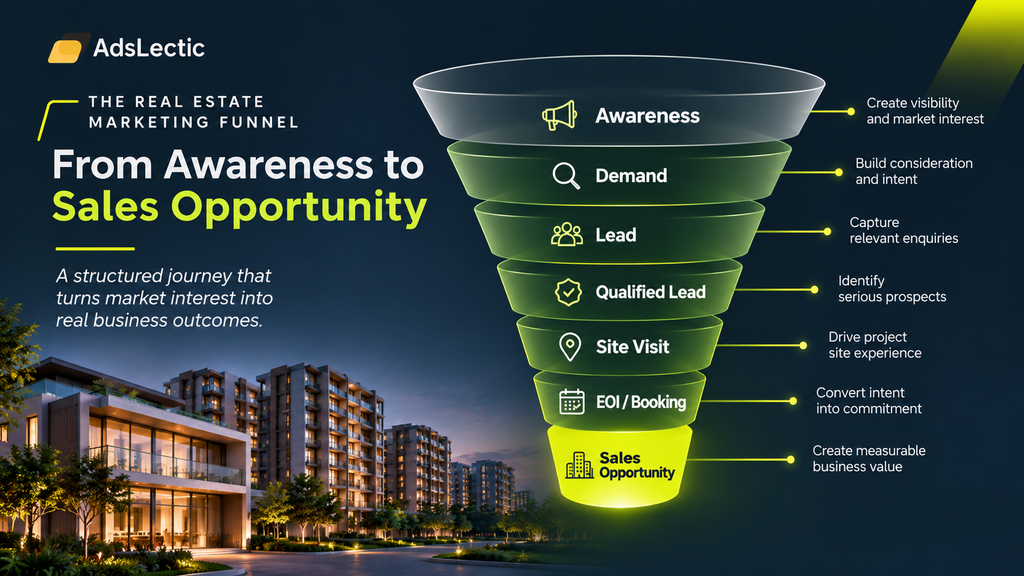
A useful real estate marketing funnel has seven stages, and marketing and sales each own part of every one.
Marketing carries more weight in the early stages, where it builds awareness and demand. Sales carries more in the late ones, where it hosts visits, handles pricing and inventory and closes. The middle is shared, and that is where most funnels leak.
| Stage | What it means | The question to agree with sales |
|---|---|---|
| 1. Awareness | The right people know the project exists | Who actually buys here? |
| 2. Demand | Relevant people show interest beyond a click, such as repeat visits or time on floor plans | Which signals matter? |
| 3. Lead | Someone leaves contact details | What counts as a valid enquiry? |
| 4. Qualified lead | The lead fits the buyer profile after a real conversation | What are the criteria for budget, location, timing and intent? |
| 5. Site visit | The buyer books, then attends | Does a booked visit count, or only an attended one? |
| 6. EOI or booking | The buyer commits, where the process allows | What happens to visitors who do not book? |
| 7. Sales opportunity and revenue | A live, valued conversation tied to sales value | How is revenue linked back to campaigns? |
The right-hand column matters more than the table. A funnel only works when “qualified lead”, “attended visit” and the other stages mean the same thing to both teams. If marketing counts a lead as qualified and sales does not, neither side can trust the numbers, and every review turns into an argument about data.
How to Build a Real Estate Marketing Strategy That Works
A sound real estate marketing strategy starts with the buyer and the economics of the project, then works outward to channels and creative. Developers who start with a channel list tend to spread budget thin and discover the problem late.
Start With the Project and Buyer Profile
Before any media plan, write down who realistically buys this project and why they would choose it over the alternatives nearby. Then ask the sales team a harder question: what separates a serious buyer from a curious one? The answer becomes your working definition of a qualified lead. It should come from real sales conversations, not from assumptions made in a briefing room.
Match the Strategy to Property Value and Buyer Intent
Ticket size changes everything. A project priced for a wider market can work with broader audiences and shorter decisions. A premium project needs a narrower audience, stronger proof and a more personal journey.
The market is moving that way. Anarock reported that homes above ₹4 crore made up about 9% of top-seven-city sales, against 1% in 2021 (BusinessWorld). Buyers also have room to be selective: Knight Frank counted roughly 509,815 unsold units across its eight cities, about 5.8 quarters of sales (Knight Frank H2 2025 report). In that setting, relevance beats reach.
Build Audience Intelligence From First-Party Data
Your own records are the best starting point: past enquiries, qualified leads, site visits, bookings and the profile of people who actually bought. They show which locations, professions and enquiry sources have produced real buyers, and which have only produced noise. Used with proper notice and consent, they can guide targeting, lookalike audiences and exclusions.
As an AdsLectic campaign example, in select audience-activation campaigns we have seen platform match rates of 30-45% when building audiences from relevant data. That is our own campaign experience, not an industry benchmark. Match rates depend on the data used, the platform and how a match is defined.
Move Beyond Basic Demographic Targeting
Age, gender and city say little about someone considering a high-value home. Stronger audience work combines professional and business signals where platforms provide them, contextual signals such as the content a person reads or watches, and behavioural signals on your own properties such as pages viewed and return visits. All of it must stay within platform rules and privacy requirements. The aim is relevance to the project, not a guess about someone’s private life.
Choose Channels Based on the Buyer’s Journey
A long channel list is not a strategy. Ask where your buyer pays attention at each stage, and give every channel a job: reaching new people, answering a search, building proof, or bringing back someone who visited. The next section sets out what those jobs usually look like.
Real Estate Digital Marketing: What Role Does Each Channel Play?
Different channels do different jobs, and the useful question is never “which channel is best?” but “which job does this one do for this buyer?”
Digital now takes the largest share of Indian advertising. The dentsu-e4m Digital Advertising Report 2026 put it at about 59% of total ad spend (e4m). That figure covers all sectors, so it shows where money is going, not what works for property. No public, independent benchmark compares channels for Indian real estate, so the table below describes roles, not results.
| Channel | Best role | What to measure |
|---|---|---|
| Google Search | Capturing people already looking for a project, area or home type | Qualified leads and attended visits from search, not clicks alone |
| Meta (Facebook and Instagram) | Awareness and consideration through visual proof; enquiries through lead forms | Lead quality and visit rate, since forms are easy to fill |
| Reaching defined professional profiles, using attributes such as job title and seniority | Qualified conversations with the intended profile | |
| SEO | Lasting visibility for project, location and buyer-question searches | Visits to project pages and the quality of enquiries from organic search |
| Video and YouTube | Showing the site, design and neighbourhood in depth | Watch behaviour as a signal of interest, then downstream actions |
| Programmatic | Extending reach to defined audiences across sites and apps | Quality of visits and later actions, not impressions |
| Premium publishers | Placing the project in credible, relevant content | Engagement with project pages and later enquiries |
| OTT and connected TV | An emerging screen for broad, often family-level awareness | Reach, with caution: audience estimates vary and measurement is still developing |
| Remarketing and CRM | Bringing back people who showed interest or visited | Return visits, booked visits and bookings from nurtured contacts |
Two notes. Real estate SEO is a long game. Google’s own guidance asks for people-first content, which for developers means useful project, location and buyer-question pages, not thin pages repeated for every locality. And real estate social media marketing works best as proof, in the form of design, progress, location and community, rather than as a lead machine on its own.
Why the Cheapest Real Estate Lead Can Be the Most Expensive
A low cost per lead does not mean efficient marketing. It can mean the opposite.
Here is why. Ad platforms find whatever they are told to find. If a campaign is optimised for cheap form-fills, the system looks for people who fill in forms easily. Those are not always the people who can buy. Sattva’s executive told e4m that campaigns can end up chasing form-fillers instead of buyers of ₹2 crore homes (e4m, September 2026). Rustomjee’s CMO called optimising for leads a mistake and described a move toward cost per qualified opportunity and revenue contribution. Mahindra Lifespaces and SOBHA have spoken about tracking cost per quality lead, site visits and bookings. These are developer views, not industry statistics, but they all point the same way.
The cheap lead carries hidden costs. It uses sales time. It can distort the numbers the next campaign is built on. And it can make a weak campaign look like a strong one.
The fix is to move the measure closer to the outcome:
CPL → cost per qualified lead → cost per attended site visit → cost per booking → revenue contribution
Each step is harder to measure and more honest. For a high-value home, spending more to reach fewer, better-matched people can cost less per booking than a flood of cheap enquiries.
As an AdsLectic example, in one campaign we recorded a CPL 28% lower than the client’s previous agency, and in a separate luxury real estate campaign a 9% lead-to-site-visit conversion. These are results from specific AdsLectic campaigns, not benchmarks or expected results, and the definitions of “lead” and “visit” vary by project. We mention them because they show why CPL and visit rate should be read together, never one without the other.
The quality of the outcome matters more than the cost of the first action.
How First-Party Data and CRM Can Improve Real Estate Lead Quality
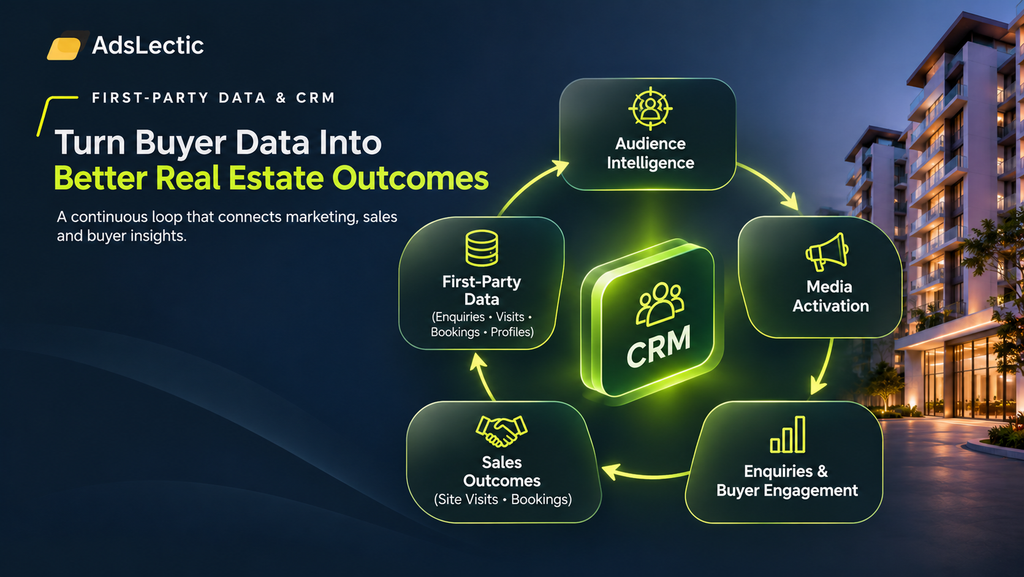
A CRM is not only a sales database. Used well, it becomes a feedback system for media.
The sales team knows things the ad platform cannot see: who answered the phone, who was qualified, who visited, who booked and who disappeared. Most developers keep that knowledge inside the CRM. The platforms keep optimising on the one signal they can see, the form-fill. The gap between the two is where lead quality is lost.
Both main platforms describe ways to close it. Google offers enhanced conversions for leads and offline conversion workflows, which allow advertisers to send later outcomes back to Google Ads. Meta describes Conversions API integrations for CRM data through supported workflows. The shared idea is that a platform can learn from what happened after the enquiry, such as a qualified lead or a visit, rather than from the enquiry alone.
In practice, this means a developer can study past enquiries, qualified leads, site visits, bookings and buyer profiles to learn which audiences, locations and creatives tend to produce real buyers, then adjust media accordingly.
Two cautions apply. First, none of this promises a performance uplift. Setup, eligibility, data quality and results vary by account, so treat the platform documents as a starting point and test. Second, sending customer data to an ad platform is a use of personal data. Consent wording, notices and each platform’s data policies all matter, and they are covered in the compliance section below.
The quality of the feedback also depends on the sales team. If statuses in the CRM are updated late or inconsistently, the signal sent back to the platform will be weak. Making CRM discipline part of the sales process, not a marketing request, is often the most valuable change a developer can make.
Luxury Real Estate Marketing Requires a Different Approach
Luxury real estate marketing is not ordinary real estate marketing with a bigger advertising budget. The pool of buyers is smaller, the decision is larger and trust carries far more weight.
That changes the work in several ways. The audience is narrower, so relevance matters more than reach. The ticket is larger, so each qualified conversation is worth more and each wasted one costs more. Consideration is longer, so a single click rarely explains a purchase. The buyer expects stronger proof: registration details, delivery record, design, location and the experience of the site visit. And follow-up becomes personal, because a generic reminder sequence rarely suits a decision of this size.
It is tempting to size the opportunity from wealth data. Knight Frank’s 2026 wealth reporting counted about 19,877 people in India with wealth above $30 million (Deccan Herald). That figure is useful as context: very high wealth in India is concentrated in a small group. It is not a count of luxury home buyers, and it should never be treated as an audience size. Wealth does not tell you who is shopping for a home, in which city or at what price.
The practical consequence is that luxury campaigns succeed or fail on audience quality and follow-up quality. A handful of well-matched site visits can decide the outcome, which is why quality measures matter more here than volume.
As AdsLectic campaign experience, we have worked on projects with ticket sizes from ₹3 crore to ₹10 crore and above, and in one targeted buyer-acquisition programme the average ticket size was ₹15 crore or more. These are examples from our own work, shaped by each project’s location, pricing and sales process. They are not market averages or expected results.
How Should Real Estate Marketing Performance Be Measured?
Real estate marketing ROI cannot be read from one number. It is better read as a ladder, where each rung sits closer to revenue than the one below it. The lower rungs help diagnose problems. The upper rungs show whether the campaign is worth continuing.
| Rung | Metric | The question it answers |
|---|---|---|
| 1 | CTR and engagement | Is the message getting attention? |
| 2 | Leads | Are people enquiring? |
| 3 | Qualified leads | Do those enquiries fit the buyer profile? |
| 4 | Site visits booked | Is interest turning into a plan? |
| 5 | Site visits attended | Are buyers reaching the project? |
| 6 | Visit done, not booked | Who needs further nurture, and why? |
| 7 | EOIs and bookings | Are buyers committing? |
| 8 | Sales opportunities | Which conversations are live and valued? |
| 9 | Revenue contribution | What business value did the campaign help create? |
Four principles make the ladder usable.
Define every rung in writing. “Qualified” and “attended” should mean exactly the same thing on Google, on Meta and in the CRM.
Share the definitions with sales. A visit rate means little if marketing and sales count visits differently.
Read results with the project stage in mind. A launch month and a later sustaining phase face different conditions, so comparing their costs directly can mislead.
Be wary of last-click credit. A property decision spans many touches over a long period, and the final click is rarely the whole story.
As an AdsLectic example, some of our campaigns have shown indicative click-through rates of 1.6% or higher. We treat that as a sign that creative and audience are working at the top of the funnel. It is not proof of business impact, and it is not an industry benchmark.
Why Integrated Real Estate Marketing Matters
A project launch has many moving parts: strategy, media, creative, landing pages, SEO, social, CRM, analytics, tracking, marketing automation and day-to-day launch management. The real problem is rarely any one of them. It is that someone needs to connect the pieces.
When the pieces sit with different vendors and teams, small gaps open at every handover. The media team optimises for a lead form. The landing-page team changes a field and nobody tells tracking. The CRM sits with sales, and its outcomes never reach the ad platforms. Each party can report success on its own metric while the buyer’s journey leaks in the spaces between them.
Integrated execution closes those spaces. Strategy, media and creative start from one buyer profile and one definition of a qualified lead. Landing pages and follow-up match the message that brought the visitor. Tracking and source capture are built before launch, so outcomes can flow back to media. Lead nurturing and automation, such as visit reminders and post-visit follow-up, run from real CRM statuses and stay within consent and telecom rules. And one report shows media, SEO, social and CRM together, reviewed with sales.
This can be achieved in more than one way. A developer with a strong internal team may coordinate several partners well. What matters is clear ownership of the connections.
AdsLectic is one example of an integrated growth-partner model, with 91 in-house professionals across Noida, Pune and Dehradun covering strategy, media, creative, technology and analytics. We mention the team size for one reason: it lets those functions work from the same brief and the same data.
Real Estate Marketing Compliance and Responsible Data Use
Good real estate advertising earns trust, and compliance is part of that. Rules differ by state and project, so developers should have their own set-up reviewed by counsel.
Advertising and registration. Under RERA, a project that needs registration should be registered before it is advertised or marketed, and advertisements are expected to show the correct registration number and website. Some states add requirements: Maharashtra’s MahaRERA also expects a QR code in promotional material (LiveLaw report on a MahaRERA penalty; TaxGuru summary of the circular). The problem is not rare. ASCI’s half-yearly report found 1,027 of 2,115 Maharashtra property advertisements it screened to be non-compliant (ASCI, November 2024).
Consent and first-party data. India’s Digital Personal Data Protection (DPDP) regime is being introduced in stages. The government’s factsheet describes consent as free, specific, informed and given by a clear affirmative action, with withdrawal as easy as giving consent (PIB, November 2025). The notice, consent and rights obligations are scheduled to begin in May 2027, so the full regime is not yet in force and dates should be confirmed before relying on them. The sensible move now is to design enquiry forms, consent wording and CRM retention with these principles in mind.
Responsible audience intelligence. Using enquiry and CRM data collected with notice and consent, within platform policies, is very different from building profiles of individuals from sources they never agreed to. If a service claims to identify wealthy individuals by combining or inferring data, ask where the data came from, on what basis it was collected and what the platforms allow. Google and Meta each have their own data and advertising policies, and calls, SMS and WhatsApp follow separate telecom rules.
A Practical Six-Step Real Estate Marketing Framework
Everything above can be reduced to six steps that a team can remember and run for any launch.
- Understand. Study the project, price band, location, competing projects and the sales team’s view of who buys. Outcome: a written buyer profile and a shared definition of a qualified lead.
- Identify. Build audiences from first-party data and relevant professional, contextual and behavioural signals, within platform and privacy rules. Outcome: priority audiences, and audiences to exclude.
- Activate. Launch media, creative and landing pages around the buyer’s next step, using channels that fit the journey. Outcome: live campaigns with tracking and source capture built in.
- Qualify. Follow up quickly and consistently, and record each result in the CRM against the agreed definitions. Outcome: qualified leads, and reasons the others were not.
- Convert. Move qualified buyers to a site visit, run the visit well and keep nurturing those who visited but have not decided. Outcome: attended visits and, where applicable, EOIs or bookings.
- Optimize. Send outcomes back to the platforms, review campaigns by qualified leads, visits and bookings with sales, and shift budget and creative to match. Outcome: a better next cycle.
The steps form a loop. What you learn in step six sharpens step one for the next phase or project, and marketing and sales should sit together for steps one, four, five and six.
Frequently Asked Questions About Real Estate Marketing
It is the work of making a project known to the right buyers, building their interest and helping them reach a site visit and a decision. For developers it spans strategy, media, creative, SEO, social media, CRM and measurement.
No public benchmark ranks tactics for Indian property, so the honest answer is principles, not a ranking. Strategies that hold up begin with a clear buyer profile, match audience and channel to the ticket size, use first-party data, follow up fast and judge results beyond CPL.
Agree what “qualified” means with sales before the campaign starts. Then build audiences from your own data and relevant signals, write landing pages that set honest expectations, qualify enquiries the same way every time and send those outcomes back to Google and Meta through their supported CRM workflows.
Executives quoted by e4m describe the gap between enquiry and visit as where much is lost. Practical remedies include quick, relevant first contact, clear scheduling with reminders, a well-prepared visit and continued nurture for people who visited but did not book.
That depends on the project and the buyer. Search captures existing intent, Meta supports reach and enquiries, LinkedIn can suit defined professional profiles, SEO builds lasting visibility, and video, programmatic, premium publishers and CTV can support awareness. Judge each against qualified outcomes, since no independent benchmark compares them.
With narrower, carefully built audiences, strong proof, personal follow-up and quality-based measures. Counts of wealthy individuals are context, not buyer lists.
Climb the ladder from qualified leads to attended visits, bookings and revenue contribution, attaching a cost to each. Read cost per booking alongside the project stage, and keep definitions identical across marketing and sales.
A capable real estate marketing agency should help define the buyer and qualified-lead criteria, plan and run media, produce creative and landing pages, set up tracking and CRM feedback, support SEO and social, and report on outcomes with sales. It should also be clear about what it controls and what depends on pricing, inventory and the sales process.
Conclusion
The job of real estate marketing is not simply to generate enquiries. It is to build qualified demand and contribute to a measurable pipeline of sales opportunities.
In a market where fewer homes carry higher value, that means knowing who the buyer is before the first advertisement runs, using your own data to find more of them, giving each channel a clear job, and listening to what sales learns after the enquiry. It means judging success by attended visits, bookings and revenue contribution, with cost attached to each, not by the size of a lead report. And it means handling advertising rules and personal data with care.
AdsLectic is one example of an integrated growth partner built around this approach, bringing strategy, media, creative, technology and analytics together around audience intelligence and measurable outcomes.
Planning a real estate launch, or looking to improve the quality of your existing demand pipeline? Speak with the AdsLectic team about how an integrated approach could fit your project.
Sources & References
- Housing sales in top 7 cities fall 14% in 2025; value rises. Anarock data, Business Standard, 26 Dec 2025.
- Premium housing rises in 2025 as affordable sales fall 17%. Knight Frank data, Business Standard, Feb 2026.
- India Real Estate: Office and Residential Market, H2 2025. Knight Frank, Feb 2026.
- Luxury’s new heights. Anarock data, BusinessWorld, Jan 2026.
- The click that goes nowhere: realty’s growing lead-to-sale gap. exchange4media (e4m), 28 Sep 2026.
- Digital commands 59% of India’s ad pie: dentsu-e4m report. dentsu and exchange4media, Feb 2026.
- India’s billionaire population may rise 51% to 313 by 2031. Knight Frank Wealth Report 2026 data, Deccan Herald, Apr 2026.
- Enhanced conversions for leads. Google Ads Help, accessed 27 Nov 2026.
- Conversions API: CRM (Conversion Leads) integration. Meta for Developers, accessed 27 Nov 2026.
- Targeting options on LinkedIn. LinkedIn Help, accessed 27 Nov 2026.
- Creating helpful, reliable, people-first content. Google Search Central, accessed 27 Nov 2026.
- MahaRERA fines promoter for newspaper ad without clear RERA registration and QR code. LiveLaw, 2026.
- Non-display of QR code in promotions of projects registered with MahaRERA. MahaRERA circular, summarised by TaxGuru .
- ASCI Half-Yearly Complaints Report 2024-25 (press release). Advertising Standards Council of India, 26 Nov 2024.
- Digital Personal Data Protection Rules, 2025: factsheet. Press Information Bureau, Government of India, 17 Nov 2025.
- Beyond Lead Generation: Is Your Real Estate Marketing Agency Delivering Real Business Impact?. AdsLectic, first-party reference.