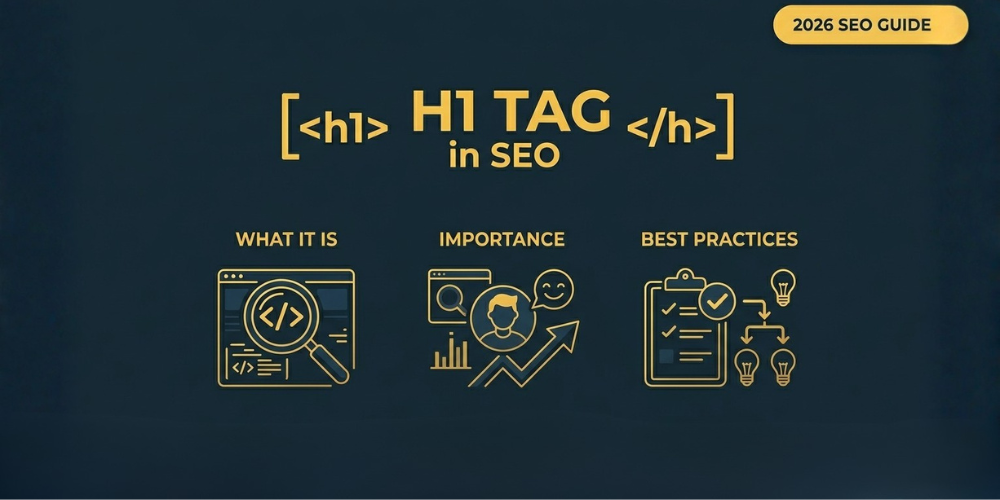
If you want your content to rank on Google in 2026, understanding the H1 tag in SEO is essential.
The H1 tag is the main heading of a webpage that tells both users and search engines what your content is about. When used correctly, it improves structure, readability, and overall SEO performance. Understanding headings is just one part of SEO — you should also learn complete SEO strategies to improve your rankings.
In this guide, you’ll learn what an H1 tag is, why it matters, and how to use it effectively.
What Is an H1 Tag?
An H1 tag is an HTML heading used to define the main title of a webpage. It usually appears as the largest and most prominent text on the page and represents the core topic.
Example:
<h1>Your Page Title Here</h1>
Think of it as a newspaper headline—it summarizes what the page is about.
Why Is H1 Tag Important for SEO?
Helps Search Engines Understand Content
Search engines use H1 tags to understand the main topic of a page. A clear H1 makes it easier for them to match your content with search queries.
Improves User Experience
The H1 is usually the first thing users see. It helps them quickly understand whether the page matches their intent, improving engagement and readability.
Creates Content Structure
H1 works with H2 and H3 tags to organize content into a logical structure, making it easier to scan and read.
Supports Accessibility
Headings like H1 help screen readers navigate content, improving accessibility for users.
H1 Tag Example (Real Use Cases)
- Blog: “10 Best SEO Strategies for 2026”
- Ecommerce: “Men’s Running Shoes”
- Service Page: “UI/UX Design Services”
Each H1 clearly defines the page topic.
H1 Tag vs Title Tag
| Feature | H1 Tag | Title Tag |
|---|---|---|
| Location | On the webpage | In search results |
| Visibility | Visible to users | Visible on Google |
| Purpose | Content clarity | SEO & CTR |
H1 is your on-page headline, while the title tag is your search result headline.
H1 Tag Best Practices (2026)
Use One H1 Per Page (Recommended)
While multiple H1 tags are allowed, using one keeps your structure clean and clear.
Include Primary Keyword Naturally
Avoid keyword stuffing. Keep it natural and readable. To write an effective H1, you first need to understand how to find the right keywords for SEO.
Keep It Clear & Descriptive
Your H1 should instantly tell users what the page is about.
Match Search Intent
Align your H1 with what users are searching for.
Keep It Concise
Short and clear headings perform better (around 50–70 characters).
Common H1 Tag Mistakes to Avoid
- Missing H1 tag
- Duplicate H1 across pages
- Keyword stuffing
- Using H1 only for styling
- Writing vague headings
How Many H1 Tags Per Page?
Modern SEO guidelines suggest:
- One H1 is ideal
- Multiple H1s are allowed
- Focus on clarity over strict rules
Search engines today prioritize user experience over rigid structure
H1 vs H2 vs H3 – Heading Structure
- H1 → Main topic
- H2 → Main sections
- H3 → Subsections
A proper hierarchy improves readability and SEO.
How to Add H1 Tag
In HTML
<h1>Main Heading</h1>
In WordPress
- Select text
- Choose Heading 1 (H1)
Does H1 Tag Affect SEO Rankings?
H1 tags are not a direct ranking factor, but they play an important role in:
- Helping search engines understand content
- Improving user experience
- Structuring content properly
These factors indirectly support better rankings. While optimizing your H1 tag improves on-page SEO, you also need to focus on off-page factors like building high-quality backlinks to improve your overall rankings.
Pro Tips for Writing High-Converting H1 Tags
- Use numbers (e.g., “10 Best…”)
- Add power words like “Ultimate” or “Complete”
- Keep it simple and clear
- Align it with your meta title
Conclusion
The H1 tag remains a critical part of on-page SEO in 2026.
While it may not directly impact rankings, it helps improve structure, readability, and user experience—all of which contribute to better SEO performance. As search evolves, combining traditional SEO with AI-driven optimization strategies is becoming essential.
A well-written H1 ensures both users and search engines clearly understand your content.
FAQs
What is H1 tag in SEO?
An H1 tag is the main heading of a webpage that defines its primary topic.
How many H1 tags should a page have?
One is recommended, but multiple are allowed if structured properly.
Does H1 tag affect SEO?
Not directly, but it improves clarity and user experience.
What is the difference between H1 and title tag?
H1 appears on the page, while the title tag appears in search engine results.