Why do some ads stop you mid-scroll while others vanish without a trace? Why do certain landing pages convert visitors into customers while others struggle to generate a single click? The answer usually isn’t better design or a bigger budget — it’s marketing psychology, the study of how people think, feel, and decide.
Whether you’re running social campaigns, writing SEO content, or building a landing page, understanding the psychology behind customer attention and decision-making is what separates content that gets ignored from content that gets remembered.
Here are five marketing psychology principles you can put to work immediately.
What Is Marketing Psychology?
Marketing psychology is the application of behavioral science and cognitive psychology to how brands communicate. It looks at consumer behavior — the mental shortcuts, biases, and emotional triggers people rely on when making buying decisions — and uses that understanding to shape messaging, design, and offers.
It isn’t about manipulation. It’s about removing friction between what a customer needs and how clearly your brand communicates that you can meet that need.
Why Marketing Psychology Matters in Digital Marketing
Every channel a brand touches — SEO, paid ads, email, landing pages, social content — is competing for the same limited resource: a person’s attention span. Psychology explains why some messages cut through that noise and others don’t.
Applying these principles consistently helps with:
- Reducing decision fatigue on landing pages
- Increasing trust before a purchase decision
- Improving engagement rates on ads and content
- Lowering bounce rates by matching message to intent
How Marketing Psychology Influences Buying Decisions
Psychologist Daniel Kahneman’s research on decision-making, popularized in Thinking, Fast and Slow, describes two systems of thought: a fast, emotional System 1 and a slower, analytical System 2. Most buying decisions start with System 1 — an emotional pull — and are then justified with System 2 logic afterward.
This is why a good marketing message usually does both jobs: it creates an emotional reason to want something, then gives a rational reason to justify the purchase.
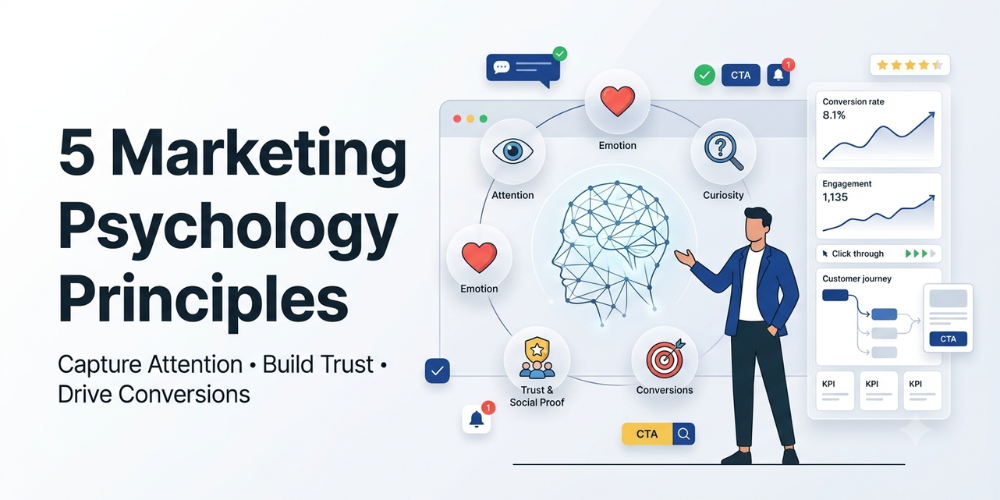
5 Marketing Psychology Principles That Improve Customer Engagement
1. Capture Attention With Visual Novelty and Pattern Interrupts
The brain is wired to filter out anything familiar. A feed full of near-identical posts trains people to scroll past all of them — until something breaks the pattern. Unexpected color, movement, an unusual visual, or a headline that challenges an assumption forces a second look.
Brands like Spotify and Apple use this constantly: bold, high-contrast visuals and short, direct copy that doesn’t look like anything else in the feed. The lesson for smaller brands is the same — the goal isn’t more polish, it’s more contrast with what’s around it.
2. Use Emotional Marketing to Build Stronger Connections
People feel first and rationalize second. A features list rarely moves someone to act; a feeling usually does. Fear of missing out, belonging, nostalgia, and relief are some of the strongest levers in marketing psychology, because they’re processed and remembered faster than factual claims.
Compare two ways of saying the same thing: “Our software saves five hours a week” versus “Get your Fridays back.” Both are true. Only one creates a feeling.
Nike and Airbnb build entire campaigns around identity and belonging rather than product specs — and it’s a big part of why their content gets shared rather than scrolled past. Authentic customer stories tap into this same emotional trust, which is exactly why user-generated content ads tend to outperform polished brand messaging — they feel real, not staged.
3. Spark Curiosity With the Information Gap
The brain dislikes an unanswered question. When people sense a gap between what they know and what they want to know, curiosity pulls them toward closing it — which is why headlines like “the one metric most marketers overlook” consistently outperform generic ones.
Used well, this isn’t clickbait — clickbait promises an answer it doesn’t deliver, which breaks trust. The information gap principle works because the content actually resolves the curiosity it creates. It’s the same logic that should guide headline writing across blog content and SEO copy alike.
4. Build Trust Through Social Proof and Authority
Robert Cialdini’s research on persuasion identifies social proof as one of the strongest influences on consumer decisions — when people are uncertain, they look at what others have already chosen. Reviews, testimonials, case studies, and client logos all reduce the perceived risk of trying something new.
This is also why reputation management matters as much as the marketing message itself; a strong campaign paired with a weak review profile still loses trust at the final step. Actively managing that trust layer — through consistent reviews and prompt responses — is core to what ORM management is built to solve.
5. Reduce Cognitive Load With Simple Messaging
More options and more information don’t build trust — they slow people down and increase the chance they leave without deciding. The strongest campaigns commit to one audience, one message, and one call to action.
This applies to page design as much as copy. A cluttered layout with competing CTAs asks the brain to do work it doesn’t want to do. Reducing that friction is also a performance issue, not just a copywriting one — page speed and layout stability directly affect how easily a message gets processed, which is exactly what’s covered in our Core Web Vitals guide.
Marketing Psychology Examples From Popular Brands
- Apple — simplicity as the entire message, not just the product
- Amazon — reviews and “customers also bought” as constant social proof
- Netflix — personalization that reduces decision fatigue
- Spotify Wrapped — a purely emotional, shareable campaign built on identity
- Airbnb — storytelling over specifications
Common Marketing Psychology Mistakes to Avoid
- Leading with features instead of the feeling a product creates
- Weak or absent calls to action
- No visible trust signals (reviews, proof, credentials)
- Generic headlines with no curiosity or specificity
- Too many competing messages on one page or ad
How to Apply Marketing Psychology to Your Business
These principles apply across channels — landing pages, paid ads, email sequences, and organic content all benefit from the same underlying approach: create an emotional hook, back it with proof, and keep the message simple enough to act on immediately.
If your content is generating traffic but struggling to convert it, the gap is often psychological rather than technical — the right message isn’t reaching the right emotional trigger. Pairing these principles with a structured, data-backed SEO and content strategy is where AdsLectic typically starts with clients facing this exact problem.
Frequently Asked Questions
Marketing psychology is the use of behavioral science and cognitive psychology to understand how consumers think, feel, and make purchasing decisions, and to shape marketing messages accordingly.
It explains the mental shortcuts and emotional triggers — like urgency, trust, and social proof — that drive people toward or away from a purchase decision.
Visual novelty, emotional marketing, curiosity, social proof, and simplicity are five of the most consistently effective principles across digital channels.
Emotional marketing is a strategy that appeals to a customer’s feelings — such as belonging, fear of missing out, or nostalgia — rather than relying solely on product facts.
Social proof reduces perceived risk. When people see that others trust a brand, they feel more confident making the same decision themselves.
By pairing an emotional hook with a clear, low-friction message and visible trust signals like reviews or case studies at the point of decision.
Marketing psychology is the broader field of applying psychological principles to marketing; neuromarketing specifically uses neuroscience methods, like brain imaging, to study those same responses.
Yes — headline structure, content clarity, and page experience all draw directly on these same principles, which is why they overlap closely with technical SEO fundamentals.
Conclusion
Marketing psychology isn’t about tricking people into buying — it’s about communicating in a way that matches how people naturally process information. Attention is earned through novelty, connection is built through emotion, engagement is sustained through curiosity, trust is established through proof, and clarity keeps all of it from getting lost. Brands that apply these principles consistently don’t just get more clicks — they build the kind of trust that turns first-time visitors into repeat customers.